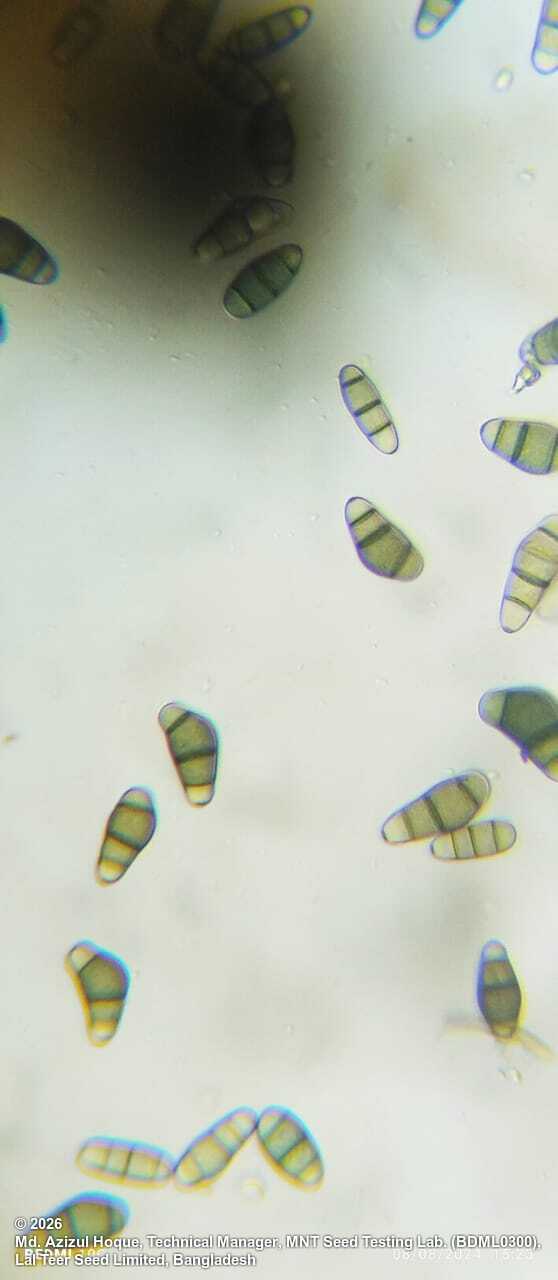
Curvularia lunata on Oryza sativa
Image credits: Md. Azizul Hoque, Technical Manager, MNT Seed Testing Lab. (BDML0300), BD
Based on the morphology, this image shows a classic example of fungal spores, most likely from the genus Curvularia. These spores, known as conidia, are characterized by several distinct features: Multicellular Structure: They typically have 3 to 5 cells separated by horizontal walls (septa). Curved Shape: A defining trait of Curvularia is the slight curve or "boomerang" shape, caused by an enlarged, darker central cell that outgrows the others. Pigmentation: They exhibit a brown or "dematiaceous" color, which is a natural melanin-like pigment.
growth time: 7 days | temperature: at 22±2°C | lighting: alternating 12 h darkness & 12 h light. | plate size: 120mm | agar: Blotter Method ( )
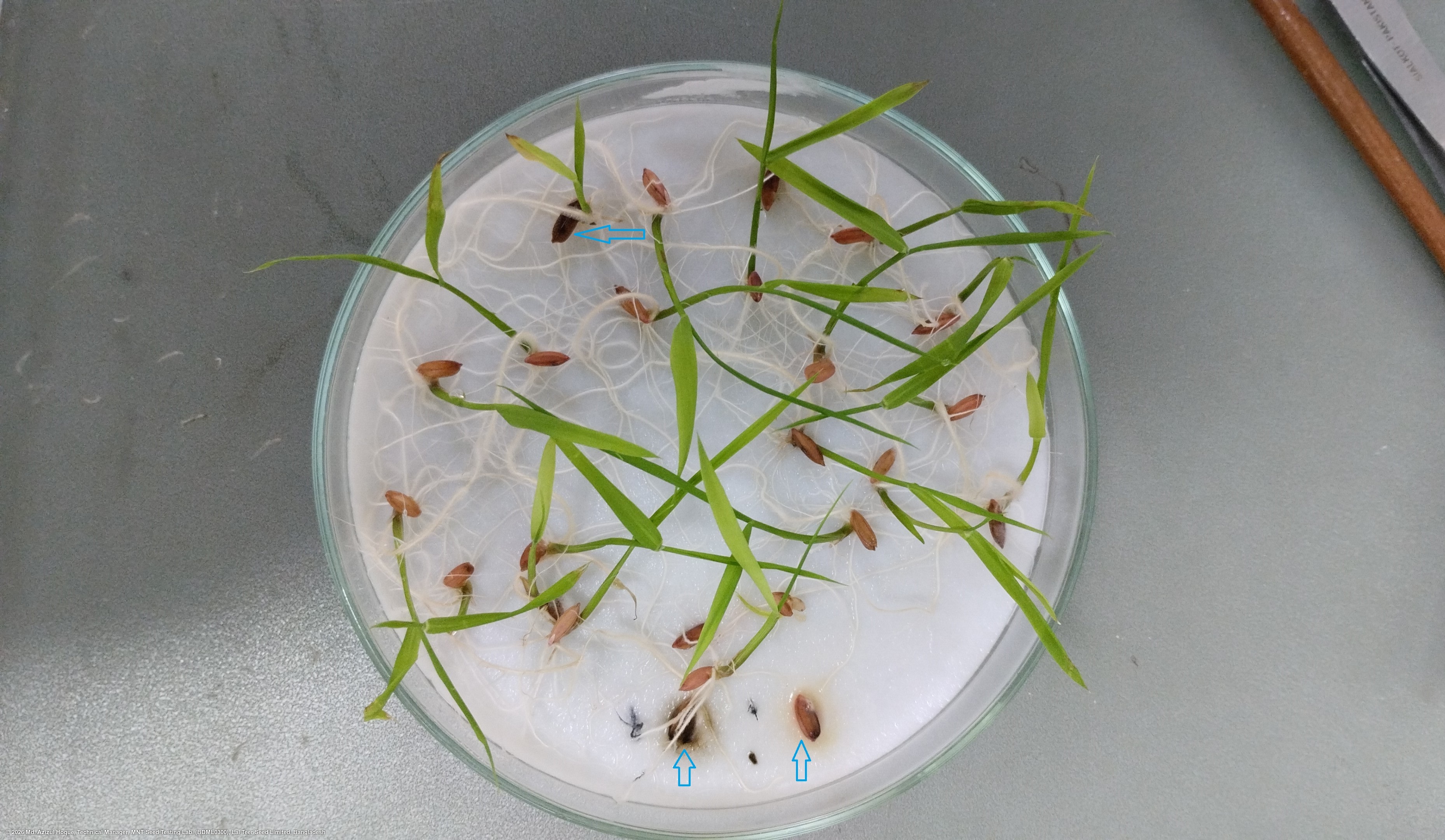
Curvularia lunata on Oryza sativa
Image credits: Md. Azizul Hoque, Technical Manager, MNT Seed Testing Lab. (BDML0300), BD
Based on the morphology, this image shows a classic example of fungal spores, most likely from the genus Curvularia. These spores, known as conidia, are characterized by several distinct features: Multicellular Structure: They typically have 3 to 5 cells separated by horizontal walls (septa). Curved Shape: A defining trait of Curvularia is the slight curve or "boomerang" shape, caused by an enlarged, darker central cell that outgrows the others. Pigmentation: They exhibit a brown or "dematiaceous" color, which is a natural melanin-like pigment.
growth time: 7 days | temperature: at 22±2°C | lighting: alternating 12 h darkness & 12 h light. | plate size: 120mm | agar: Blotter Method ( )
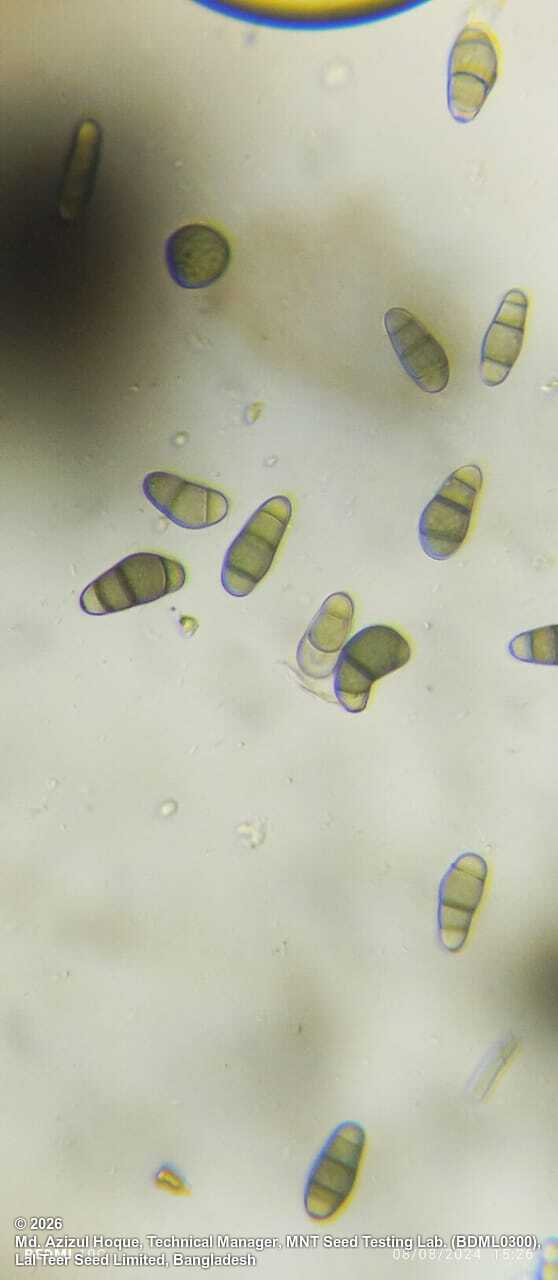
Curvularia lunata on Oryza sativa
Image credits: Md. Azizul Hoque, Technical Manager, MNT Seed Testing Lab. (BDML0300), BD
Based on the morphology, this image shows a classic example of fungal spores, most likely from the genus Curvularia. These spores, known as conidia, are characterized by several distinct features: Multicellular Structure: They typically have 3 to 5 cells separated by horizontal walls (septa). Curved Shape: A defining trait of Curvularia is the slight curve or "boomerang" shape, caused by an enlarged, darker central cell that outgrows the others. Pigmentation: They exhibit a brown or "dematiaceous" color, which is a natural melanin-like pigment.
growth time: 7 days | temperature: at 22±2°C | lighting: alternating 12 h darkness & 12 h light. | plate size: 120mm | agar: Blotter Method ( )
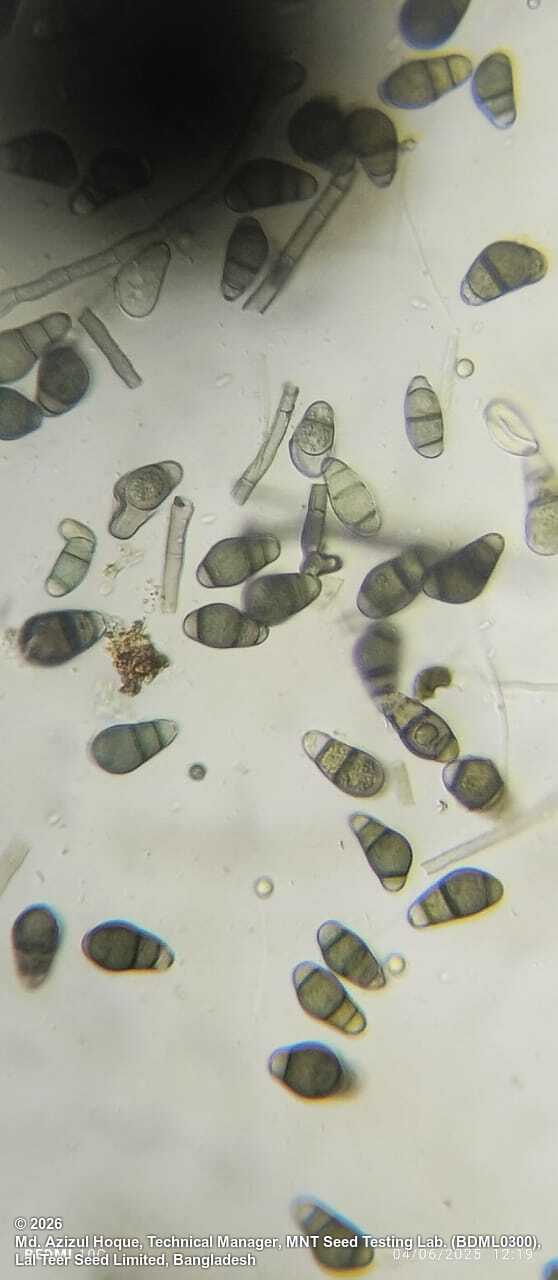
Curvularia lunata on Oryza sativa
Image credits: Md. Azizul Hoque, Technical Manager, MNT Seed Testing Lab. (BDML0300), BD
Based on the morphology, this image shows a classic example of fungal spores, most likely from the genus Curvularia. These spores, known as conidia, are characterized by several distinct features: Multicellular Structure: They typically have 3 to 5 cells separated by horizontal walls (septa). Curved Shape: A defining trait of Curvularia is the slight curve or "boomerang" shape, caused by an enlarged, darker central cell that outgrows the others. Pigmentation: They exhibit a brown or "dematiaceous" color, which is a natural melanin-like pigment.
growth time: 7 days | temperature: at 22±2°C | lighting: alternating 12 h darkness & 12 h light. | plate size: 120mm | agar: Blotter Method ( )
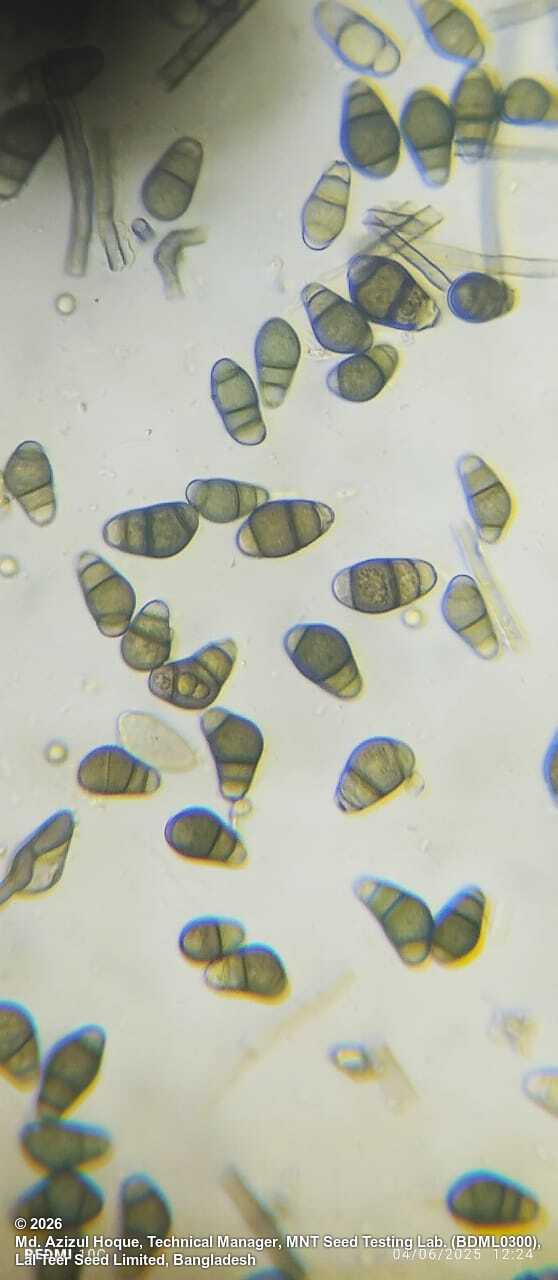
Curvularia lunata on Oryza sativa
Image credits: Md. Azizul Hoque, Technical Manager, MNT Seed Testing Lab. (BDML0300), BD
Based on the morphology, this image shows a classic example of fungal spores, most likely from the genus Curvularia. These spores, known as conidia, are characterized by several distinct features: Multicellular Structure: They typically have 3 to 5 cells separated by horizontal walls (septa). Curved Shape: A defining trait of Curvularia is the slight curve or "boomerang" shape, caused by an enlarged, darker central cell that outgrows the others. Pigmentation: They exhibit a brown or "dematiaceous" color, which is a natural melanin-like pigment.
growth time: 7 days | temperature: at 22±2°C | lighting: alternating 12 h darkness & 12 h light. | plate size: 120mm | agar: Blotter Method ( )